Wednesday, August 22, 2007

Being looked at

I was on television the other day. Watching the recording afterwards was weird, like watching a ghost.
The human gaze assesses you. Addressing "the public" can be euphoric or horrible. The public doesn't have to fill a huge lecture hall. We've all been there in the school playground. It's the configuration that counts. It's you at the focus, and - it need only be three - the public arranged around you in that imprisoning curve, facing in. With rapt attention. Or excited anticipation of violence upon your person. Or active indifference, their stony gazes all slightly elsewhere.
This is the prototype public gaze. Anybody who has addressed the class, or the lecture hall, or the hobby or lobby or pressure group, and failed to make contact with a single pair of eyes, failed to elicit a personal response, even if it's only a puzzled frown directed into the inside of your head - but hopefully it's a nod and smile - will know the cold sweat, sinking horror, barely controllable urge to flee. Experienced mass communicators single out individuals for that reason, not just to display the human touch, but to be welcomed by another human being, to fend off the terror of isolation. Because our evolutionary group instincts are strong. We know that if we are isolated like this for long, they are going to kill us.
I hate being looked at. I am sitting at a meal, or standing at a party, and suddenly somebody will ask the question, whatever it is, that amounts to "Who are you?" "What are you? "How do you define yourself?" And because there is a lull in interest elsewhere, eyes turn towards you. And my top lip instantaneously bubbles sweat, and I panic, and gabble something along the lines of, "Nothing, really. Oh my goodness, just look over there."
But put me on a stage, or even give me my head in a bit of political street theatre, and I'm away. I can perform, but I cannot merely be, not in any open or transparent sense, in public.
Nevertheless situations arise. J, the other half of Ogo Press, has been writing round to friends, many from the middle reaches of the past, to publicise Torc. My god, what distinction so many of them have achieved, as writers, professors, directors, even a successful global investment fund manager. While I, well here am I, perfectly undistinguished, lacking the slightest blip of emininence.
Such as I am, like most people this side of the manic I guess, I spend time being quite depressed about myself and time feeling quite pleased. I brood on the fact that I am an idle waster, and then on the fact that I am brooding on my idle waste rather than getting on with the kind of energetic and in their own way world-conquering things that other people do. Then I have a cup of coffee, re-read a review, look at a bit of work, and feel quite self-assured. So it goes on, up and down and round and round until, I guess, we are run over by a bus or too old to care.
But now, on Amazon, in order to encourage people to buy this book - the commercial imperative - and to read it - the egotistical imperative - I have to write about myself, because Amazon suggests the publisher do that, and I am the half of the the publisher who is meant to have imagination. I have to make myself sound attrative, and dynamic, and exciting, and as close as decently possible to being a genius while still keeping the slight contact with "objective reality" that we politely refer to as the truth.
The post below is what I wrote - it's not on Amazon yet because they say it takes five business days; and maybe they have some sort of decency filter which vapourises hyperbole.
Was it hard to do? Did I quail and sweat and want to flee the page. Certainly not. I enjoyed it. You should try it. Write your own three line eulogy. It's pure performance, exhibitionism, a virtuoso act. Do it. Share my shame. Don't miss the opportunity. It'll become just another part of you, and one that's worth having.
But I still hate people looking at me.

Torc - ISBN 9780955590603

These short stories range from the familiar and familial to the bizarre and the, in that seductive "Oh no, oh yes, oh no" kind of way, quite shivery. There is human sacrifice by a Swedish summer lake, and the murder of a voluptuous American tourist in Spain's other Versailles by a guerrilla troupe of ultra-European actors. An invisible shepherd mines a golden sexual vein in a Greek palace three thousand years ago. An old woman has visions of eastern orgies and transcendental holiness through the hedge of her very English terrace garden. A young woman from a failing central African state, swathed in a burka, meets an M15 spook in a London park to address the matter of her president's forked penis and his predilection for the discipline of traditional nursing. Nearer home, a good husband dallies with his mistress while his wife takes a succession of driving tests; and an elderly couple visit a computer screen to be informed of the cosmetic, and other, possibilities of genetic engineering. Elsewhere, holy adultery is practised and explored while raging old men expound the Abrahamic law.

Those already familiar with Waddington's style will recognise the slightly narcotic combination of the sensual and the cerebral, the arrestingly elegant and the look away crude. You are lulled as you are lured, charmed as blades are unsheathed, and you are left, more alive than before, with strange reflections playing across the shadows of your mind.

James Waddington has published a novel, Bad to the Bone [Dedalus 1998], which has been translated into French, Italian and Russian. Some of his short stories have appeared previously in magazines and anthologies. He writes and broadcasts on drugs in sport, theories of culture, the enigma of religion, bicycle technology; and any combination of any or all of the above.
© Amazon

Monday, July 30, 2007

Amazon

The web is a wonderful place, and Torc appeared on Amazon without my contacting them at all. It's one of those useful but scary things, like being able to pay your car tax on line. How do they know whether you're insured or not? But they do - and that thing you were thinking about three hundred and seventy two seconds ago, they have that up on screens with your mugshot in the sidebar from Pontypridd to Llandudno ; so be careful. The DVLA in Swansea know everything. And they pass it on to Amazon.
Or the other way round.
Get a grip, man, get a grip. OK, just click DVLA Swansea and it should get you straight through to Torc on Amazon.
Or, if you want to go the conventional route, just click Amazon.co.uk.
Oh, and if you want to tax your car, click The Third Policeman by Flann O'Brien aka Myles na gCopaleen

Wednesday, July 18, 2007

Torc


More than a year since I posted to this blog. The dark is closing in. The crows dodge closer each time they drop by. Each eye glinting towards me asks the same tactless question. Days ago I saw a figure on the road between the rocks, but it came no nearer.
The last wheat grains are gone. Larvae loop and slide in the dregs of the water barrel.
No, not really. I've been working on a book, Torc [October 2007].
You only publish a book yourself for one overarching reason - because nobody else is going to do it for you.
Once that is out of the way, there are other good reasons. You have total responsibility and, up to the time it goes to the printer, control. You learn a bit about typesetting and Photoshop and html. You can design the cover. You can give your existential angst a workout over fonts, kerning and the black hole of rasterisation.
Everything takes a long time. I spent most of yesterday just making a web page of review quotes from my last novel (that one published by a mainstream publisher).
Another thing publishing your own book does is raise the question, what's the point? What's the point particularly if, like me, you are not a writer of great significance. We won't necessarily agree who these writers of great significance are, but we know they exist. Last night I finished Chimamanda Ngozi Adichie's Half a Yellow Sun. Some books add to the cultural core of what it is to be human. This may well be one of them.
But, and it's an important but, there aren't so many. Off the top of my head, there's Orhan Pamuk's Snow , that kind of thing - and David Mitchell's Number Nine Dream and Cloud Atlas, Art Spiegalman's Maus and Yasher Kemal's Salman the Solitary; Doris Lessing's Golden Notebook. But how many of those are there from this and the last century? Not so very many.
Which leaves all the other books - including a lot written by "our greatest living fiction writers". And here suddenly we are in a different game, the game of what goes on in writing when one is not writing a work of enduring and universal significance. Which, nine hundred and ninety nine times out of nine hundred and ninety nine, one isn't.
But even with the not-at-the-core-of-universal-human culture books, there are two kinds of fiction, just as there are two kinds of reader. There are readers whose reading is like their conversation, a continuous rehearsal of what they already know; and those for whom reading is a leading part of the part of them that is always on the move, constantly exploring and engaging and changing.
So, I mean to say, where are you as a reader and where am I? Well, obviously!
That's why I write and who I write for; myself, in the second category; and you, likewise.
Take the shortest story in Torc.
When J read it, she said, "Why does it have to be a Jew?"
"Because," I said, "it's a traditional story. In the original story of Harun el Rashid and the seer, the seer was a Jew. Jews at that time in that place were not conceived of in the complex way they are now, after another thousand and more years of brutal history have gone by. Jews were respected and admired as wise and philosophical. That's part of the point of the story."
"But," J said, "you're not telling the story more than a thousand years ago. You're telling it now. Surely you've got to take the modern context into account."
"No, I don't think I do," I said - because once I've written something and I think it's good I get quite cross when anybody suggests I change a word. I often give way in the end, but with sorry grace, even when I know that I'm wrong and they're right.
So the seer remains a Jew, as he was in Harun's day. A Jew who makes an interesting but fatal mistake.
That raised questions twelve hundred years ago. And it raises the same, and other, questions today.

Wednesday, May 10, 2006


The quince makes it into spring
© Jago

Leaves are so fashionable
© Jago

Au revoir

Well that's it for a month or so, friends. I'm off to see people in France and Italy, and may or may not get near a computer with enough intelligible going on in my head to commit to the great out there. I'll take a camera. Meanwhile I leave not only you, but my seedlings. The heartstrings twang. Hasta luego.

Tuesday, May 09, 2006

Heroin and fragmentation bombs

Whenever a drug dealer’s £50,000 motor goes by I think, tax them.
There are two top criminal enterprises in the UK; the drugs trade; and the MOD/”defence industry”.
When I say criminal, I don’t mean, as in morally wrong. I mean, as in criminal.
Tax the drug trade, give less to the “defence industry” (clearly I don’t mean skimp to the very edge of terminal scandal on the equipment of actual soldiers, sailors and airwomen, as has been the “winners do what it takes” philosophy since at least 1979. I mean take away the astronomical topslice that goes to the big league criminals.)
MOD/”defence”.
The drugs trade.
One legal.
The other not.
Just reverse them .

Monday, May 08, 2006


Wilfrid Ewart

Tomorrow in the battle think of me

Wilfrid Ewart was my grandmother’s brother. He is a significant, if bizarre, player in Javier Marías’s novel Negra espalda del tiempo. Having survived a large part of World War one in the trenches Ewart was found shot through the eye, a pool of blood on the balcony, in his room in the Hotel Isobel in Mexico city on the morning of New Year’s day 1922. He had written a successful novel,Way of Revelation, a period piece; and also - to my mind one of the all-time great bits of journalism about the Irish troubles - A Journey in Ireland, an account of a walk from Cork to Belfast in 1921 when he was captured both by the English and the IRA.
Marías draws on Hugh Cecil’s The Flower of Battle but my memories of my great uncle, derived from a sort of time travel to an old country house where apparently some of the dead end up, are different. Here is one:

I was sitting in the boothouse with Jack, and in comes Wilfrid, tall, hot cheeked, exquisitely turned out, distressed, still holding his starched linen table napkin with `Lion and Garter Hotel, Oxford` embroidered in one corner.
"Wisha," says Jack, reading the symptoms, "what’s wrong now?"
"They were making the most unsavoury suggestions."
"Who, now? Come on and be sitting yourself down and I’ll pour you a cup of tea."
"It’s not the hour for tea. I’ve just had coffee." But Wilfrid sat himself down on the stool, in a triangle now with Jack over towards the big coke boiler and the tea things and me on my jam tin under the small window so thick with webs that it let in only the gentlest and coolest of the light. Jack got up and went to the stove and the blackened kettle that also did as a teapot. He poured tea for no-one but Wilfrid, nor did he ever take Wilfrid at his word when he said he didn’t want the tea. Sure what was the point of coming to the boothouse at all if you didn’t want a cup of tea.
"Oh very well, as you will." Wilfrid took the mug and sipped noisily, slurping off the surface ripples under his perfectly trimmed moustache.
"Now," said Jack, "tell us what ails you."
"Nothing ails me. What should ail me? Fit as a flea. It’s this unwholesome obsession with sexual matters."
"Oh aye, and how did that come about?"
"They were having another go at me about Dolly Rawson’s breast."
"And which one was that?"
"Which one, how should I know which one. What do you take me for?" Wilfrid closed his eyes with a put-upon expression, almost as if he was about to whimper. "The left," he said, after a few moments.
"Beneath which the heart beats," said Jack. "No, I meant which one was Dolly Rawson. I don’t recall."
"For Pete’s sake, man, get a grip of yourself. There’s only one Dolly Rawson."
"Of course," said Jack, "of course there was."
We were on difficult ground. Wilfrid was so fastidious.
And yet Marías, making the point that the putative site of Ewart’s death, by stray bullet, in a puddle of blood, became a selling point for many hotels in Mexico City which could only fraudulently make that claim, writes: `El poeta canadiense Witter Bynner y su amigo William Johnson siguieron a Lawrence (David Herbert, el célebre responsable de El amante de Lady Chatterly) y su esposa a la ciudad de México en marzo de 1923 para descubrir que Lawrence les había reservado alojamiento en el Hotel Monte Carlo. Los dos se escandalizaron al darse cuenta de que por un extraña coincidencia su cuarto anteriormente había sido ocupado por un amigo de los cuartro, un inglés llamado Wilfrid Ewart.`
A friend of all four of them! Wilfrid, this great uncle of mine sitting in the boothouse talking about "unsavoury suggestions" was a friend and presumably an admirer of the writer of Lady Chatterly whose gamekeeper, as I remember, says things like... well, you’ve no doubt read it yourself.
"Look," said Jack, "did we not have this very conversation every day for the last infinity of days, did we not have it but an hour ago, and did we not say that, would you want Dolly Rawson to be not a girl, not a young woman at all, but a fine young boy, clean of limb and golden of mien and as beautifully spoken as you could wish and entirely of your own mind, then sure would that matter a jot or a tittle, and sure it would not."
Wilfrid turned his cold patrician gaze upon the black boot boy. "Why?" he said. "Why this obsession among the low born, the prospective bride’s mother, Boots, with perversion and vice? Have I ever, for one moment, suggested that I was a secret sodomite? Have I ever suggested that I entertained within my bosom a festering desire to commit lewd and unnatural and deeply repellent acts?"
"Well put like that," said Jack, "no, I suppose you haven’t."
"Suppose?" Wilfrid had an unpleasantly petulant shriek for so tall and imposing a man.
"Och calm down, for Christ’s sake," said Jack. "I’ll tell you the beginning of a wee and very short story, and you can tell us the end."
In fact I recognised the story, it was some Irish man of letters, not Joyce, certainly not Becket, possibly Yeats though a bit common for Yeats, maybe St John Gogarty, or Synge; I bet it was Synge, almost certainly Synge. But Jack it was who seemed to recall, "I was walking once between the bog and the mountains, oh it was one of those days of summer with the bees in the heather and the smell of the whin flower on the breeze, and larks never the one wasn’t singing when the other dropped to earth, and I’d been on my feet since dawn, and not a soul had I seen but the odd turf cutter in the distance, and one cart upon the road, and up afar a wee cabin, back from the road, with, you know, roses and willows, so I turned towards it to get me a drink of water and maybe a bit of bread, and I came to the half door, and knocked upon the lower half which was closed, and there came a woman, a fine young woman, and all she had about her was her skirt wrapped at the waist, and she said, I’m all alone, ‘tis a month back since my only man was buried.' "
He stopped. Wood pigeons cooed in the elms. A large tortoiseshell flew in the door, and out again. The coke stove muttered its acrid internal flare, deep within its huge cast iron belly. There was, inevitably, the murmur of innumerable bees.
"Well?" said Wilfrid.
"Let me read you a minute." Jack went over to the dark back of the room where there were shelves of a sort for his equipment and tools, and took out a volume bound in green linen. He sat down, opened it, and began:

But a mile further on a shifting patch of blue vividly contrasted with the hillside’s emerald green. A dark-haired handsome girl accompanied by a child came down the roadside.
“And where might you be making for?”
“Tullamore.”
“Have you your fiddle with you?”
The girl looked meaningly at my rücksack.
“Are you not the fiddler from Tullamore? Will you play us a tune?”
“I am travelling though Ireland. Perhaps I shall write an account in the newspapers.”
“Is that so? Will you give me one then?”
To be taken by the same person for a local fiddler and a vendor of newspapers is not everybody’s experience. Our colloquy continued for some minutes. When I continued my journey the girl and child were laughing amazedly, still unable to make me out…
After a while I sat down to rest near a cottage. An unkempt peasant woman brought me a glass of milk…

Jack paused, his finger on the page. "Well?" he said.
"Well what?"
"Do you recall her countenance?"
"The unkempt peasant woman. She was not attractive. She was a slattern."
"Ah come on now, sir. She gave you milk, you took the milk, you drank the milk, she refused payment. She was a decent woman. Just a little déshabillée, maybe."
"Killing. Absolutely priceless."
"What’s that then?"
"Your lingo. I mean, Boots… Déshabillée. Priceless."
"Je voudrais," said Jack, unperturbed but steady and meaningful, " vous rappeler que pendant la guerre quand nous étions par example à Paris q’étais moi-même, d’habitude, quand nous nous metions dans quelque mauvais pas, c’était moi qui pouvait nous nous tirer de la merde, par ce que vous, monsieur, vous parlez Français comme un cheval."
"Didn’t I say he was killing?" Wilfrid turned to me, almost giggling.
"And was she?" I asked.
"Was she what?"
"Déshabillée."
The shutters came down again. "Certainly not. As my man here has pointed out, she was a perfectly decent woman, if scruffy."
"Ah, but it’s the other," said Jack, "that dark-haired handsome girl, that your man here is interested in. Now what was she saying to you there?"
"I have written it as it was. It is transcribed from my notebook."
"No, what was she saying to you? She asks if you’re the fiddler, she says will you give her a tune. You talk about newspapers. She asks will you give her one then. Man, sometimes I think you are the dumbest individual on God’s whole earth."
Wilfrid glared at him with a very confused expression.
"Was she beautiful?"
"I’ve said, she was handsome."
"Was her hair up or down."
"As I remember, it was gathered at the nape of her neck. She loosed it as we talked."
"Oh, Jesus, there’s some great tragedies in this world. Was it lank, was it dull like a donkey’s back?"
"It fell in coal black glossy curls all the way to her waist."
"A hunched back was it?"
"As straight as a hazel wand."
"And loins like a lyre, no doubt. Well, the legs on her, maybe they’ll be the saving of us yet, the legs on her, are we talking Mullingar heifer here, are we talking beef to the heel?"
"As I remember, they were good enough legs to dance the night away."
"A slender lass - but, don’t tell me, with a chest as flat as a board."
Wilfrid sobbed.
"History, repeated as farce," said Jack in perfect mimicry of Wilfrid’s beautiful pre-1914 accents.
"It was not a farce."
"But you write, `When I continued my journey the girl and child were laughing amazedly...”`
Wilfrid put his face in his hands and wept, and Jack made no attempt to comfort him. Eventually he raised his noble head, a few spikes of the manly coiffure sprung free, as when bits of veneer are lifting. "There was a child with her, for god’s sake."
"Waiting to be sent home with a silver sixpence."
"I don’t believe in droit de seigneur."
"I’m sure no more did she. I don’t know what she believed in. Sure I don’t know what my own Ma believed in, but I was real enough, and none the worse for it, no more than your average human being, conceived, born, not yet dead. All I’m telling you is the honest truth."
"You’re telling me nothing, nothing, nothing," screeched Ewart. A stagger and lurch, the door like a camera shutter opening and closing its tall rectangle of blinding light.
Jack sat twiddling his thumbs for while. "Huish," he said.
"Clos," I agreed.

Sunday, May 07, 2006


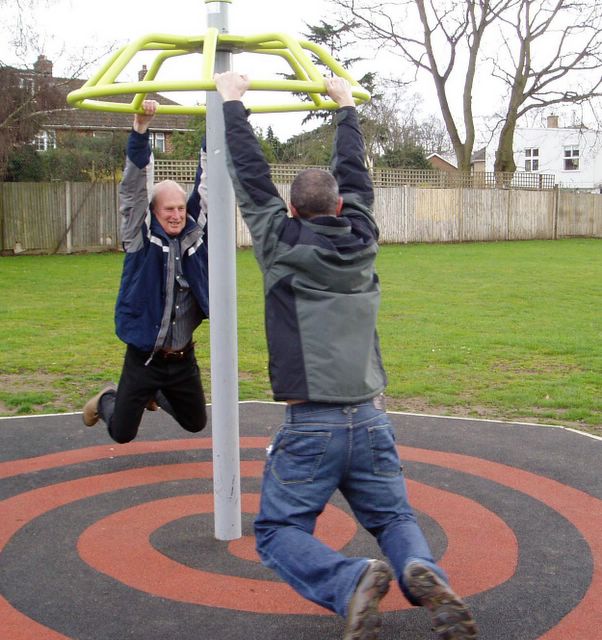
Jago&Son take the children to the playground
© Jago

Jago&Son take the children mountain biking
© J

SVT again

The next time my heart started beating at three times its resting rate I knew what caused it. We were staying with friends. The previous day I’d had a hard bike ride, then we’d driven up to Cumbria, and him now known as Renman and me had sat down late at night to finish a bottle left over from supper and then, you know how it happens sometimes, drifted into that state where duty, however painful the consequences, prevents one going to bed until every available bottle has been emptied or one falls lifeless.
The next morning, Sunday, J and I went for a walk on the shore, I walked up a sand-dune, and bingo, rat-ta-ta-ta-tat.
Four hours later, and this time I really did need persuasion, I ended up in a doctor’s surgery in Wigton, though the doctor was not a man of Wigton, he expatiated on what he told me were dissident but undoubtedly correct Russian theories while he spent an hour or so connecting me to his laptop. Then he spent another twenty minutes looking at the screen before suddenly muttering a name I didn’t catch, sending for an ambulance, and fiercely listing all the pleasures of life known to man, finally thundering that they were not for me, no more, not one, not ever.
After ten minutes of this the paramedic and ambulance driver entered with a wheelchair. I said I had already walked about three miles in my present condition and could for sure make it to the ambulance. They spoke of regulations, they were liable to be sued and sacked if I didn’t comply, I sat in the wheelchair, was wrapped in a blanket, tied in with a leather strap in case I fell out, totally invalided and infantilised in ten seconds flat, wheeled twenty metres to the ambulance. Which I was allowed to enter under my own locomotion, put on a bed, connected to a beeper, given a tablet which I had to keep pressed against the roof of my mouth, and we set off for Carlisle with J following behind in the car.
Somewhere on the way I dozed off for a minute. When I came to my heart was beating normally. I told the paramedic my news. We could stop, transfer me to the following car, we could all go home.
This was not the case.
Instead I ended up in a room of my own in the hospital, looking out through the window onto a ward where people of both sexes, most of them getting on a bit, were lined along the walls in beds so close together it was a wonder the nurses could work between them. My room was spacious and full of high tech equipment to which I was connected by many wires.
My heart was constant at about seventy. I felt fine. Nurses moved around me. One, a short young woman, had a clipboard and was asking me regulation questions. She came to religion.
“None,” I said.
“No,” she said, “what religion are you?”
“I’m not,” I said. “Honestly.”
She started to rise slowly and smoothly into the air. My eyes were fixed on the successively revealed zones of her body, waist, hips - when her shoes went past I would know, but I didn’t want to leave it that long.
“I’m whatever religion you are,” I gabbled. “Your religion, that's what I am.”
She seemed irritated. I looked away. The whole room was rising. Or rather a nurse the other side of the bed had pressed a button and my bed was slowly and silently sinking on its big metal slider.
“OK," I said, "no religion.”
She stabbed the clip board with her pen, sighed, and departed.
A houseman came to see me. We hit it off, one of those easy relationships that seem to have been there for ever, though you’ve never seen each other before and never will again. He looked at the computer analysis. “There could be, just a chance, Wolff-Parkinson-White syndrome. I’ll go and see what my Registrar thinks of that.”
In his absence an elderly auxiliary with another clipboard came and asked me what I would want for supper. I said I wouldn’t need any, I was going home.
“You’re right” she said, “you don’t want to eat here. This is a PFI hospital. It doesn’t have a kitchen. The food comes up the motorway from Manchester in containers. The scrambled egg is frightening.”
The Houseman came back. We chatted a bit more. Then he sighed. “My Registrar thinks nothing of the Wolff-Parkinson-White syndrome hypothesis.”
I began to commiserate. “No, no he said, "it’s excellent. He’ll come and see you, then you are free.” He gave the impression that no such joy was in sight for him.

The Registrar was very like the Houseman, but older, at least thirty, and wearier. He gazed at me objectively for quite a few seconds. “People like you” he said. He paused to let the unsaid sink in. It sunk in like this; my heart had probably cost the National Health Service - what? - £1-2,000, half of which would have gone in accountancy fees, management costs, failed management severance allowances, PFI repayments, PFI re-mortgaging for profit withdrawel, headquarters costs, the cost of transporting warm scrambled eggs in sealed containers the 170 kilometres from Manchester.
I started to say that it wasn’t my idea to come to the hospital, it was the women in my life, it was the doctor in Wigton...
“Yeah, yeah, yeah,” he said, “with his Russian theories.” I had already realised that whatever I said was just digging the hole. He told me a couple of things to do if it happened again, basically a sudden compression of the thorax, coughing or trying to suddenly expel air while holding your breath. “Bye,” he said. He too was a pleasant man.
I thanked the nurses and J and I walked out through the long PFI style ward with its beds of old people too close together for the nurses to work properly. When we got back to our friends she who is now known as Renwoman had cooked a delicious, convalescent friendly fish pie, with which I drank only a small glass of wine.

Thursday, May 04, 2006


Above Dollar Ogo
Go back fifty years at the right moment, this punt would be at sea below.
© Jago

Labour burns

Reports are coming in that the NewLabor shuttle, attempting to return with 87% of its heat shield tiles damaged or missing to its now alien home planet of Democracy to pick up much needed supplies (which the Captain had boasted they could survive indefinitely without) has burnt up on re-entry.
This has not yet been confirmed.
Sadly, I have no idea whether this is true. It came to me, as of a voice from the heavens (oxygen starvation) near the top of a lung-bursting climb.
No doubt the few remaining rank and file Labour loyalists would complain that it is just this sort of childish nonsense which drives their bosses into extremes of knee-jerk authoritarianism. I am suitably chastened.

SVT

Last week my heart started skipping a beat. That’s how it felt. It would beat fifty-six times quite regularly, and then - the fifty seventh wasn’t there. I had to wait for the fifty-eighth. At first I thought I’d just missed it, moved my finger or been distracted. I asked J to take my pulse. She confirmed the phenomenon though, as we never see anything in quite the same way, she described it slightly differently.
I’ve had trouble with my heart before, but it’s been straight supraventricular tachycardia where the heart beats between 140 and 240 times a minute, sometimes for several hours. (Should you already be touching the corner of a handkerchief to you eye, deeply affected by my matter-of-fact heroism, I should mention that am no more on the verge of death, or even debility, than normal, which is not much so far.)
A slight digression about death. Daughter T and son M were up for Easter with their children. This being a 1790 merchant clothier’s house (of which we inhabit a third), the second storey was once a weaving room, with something like twenty six windows, and is now our living room. It covers the whole of the house, with the main chimney stack, a substantial block of masonry, going up through the middle.
Every night in the summer J goes into the garden last thing to hunt for slugs. This particular evening as we’d sat long at the table, she decided to go out on her slug hunt as I was clearing up the kitchen. She told me she was doing that. I registered that she was doing that. I then, when I had finished in the kitchen, a quite automatic routine, completed that routine by locking the outside door, and I went upstairs to join everybody else.
After maybe fifteen minutes M said, “Is that the bell ringing? Where’s Mum?”
“She’s out in the garden catching slugs,” I said. Then I connected two parts of my brain which had been out of contact.
J has many wonderful qualities. Sweetness of temper under all circumstances is not one of them. I was down the stairs, two flights, spiral, in 1.7 seconds (possibly the onset of the ectopic superventricular episode, though I haven’t made that connection before). J had been standing in the cold night for ten minutes. I made my peace with her, referring to the romantic beauty of the stars &c., as best I could, which was imperfectly.
An hour or so later, when we were again relaxed together, M had said that while we were downstairs T, the eldest, had instructed him and A that when we got back up again nobody was to, under any circumstances, laugh. Everybody had agreed that this was a good plan. She had then, as J and then I crested the rise, run to hide behind the chimney, making strangulated noises, and only emerged two minutes later, eyes wet.
The kids got into recounting difficult moments with us. E.g., the day before M and I had been up at a quarry on our mountain bikes. There was a particular drop that I wanted to try, but only when someone else was there to pick up any remains. It turned out to be straightforward, but from above, about a metre and a half of it looks vertical - nothing to the hard guys, but scary enough to the likes of me. M said that while I was doing it he was thinking to himself, “I hope he doesn’t kill himself now. In the general scheme of things it would be no bad way for him to go, good in fact. But - I’ll have to tell Mum. How do I do it? Do I ring her on the mobile and say, yes, yes, we’re having a great time, but, oh, and by the way.... Or could I sneak back, take the car and drive back to London, abandoning wife and children, and wait for things to sort of sort themselves... or... And wine being the trigger to much invention, we joined him in this amusing speculation.
So my death, like everybody else’s, is a permanent possibility.
The first time I had ectopic superventricula tacychardia our GP gave me a special note for A&E which got me straight through the waiting drunks and sports injuries and onto one of those hi-tec beds from the starship Enterprise, connected to a machine that went beep-beep-beep twice a second.
The young registrar - I use that term at random, I know nothing about the hierarchies of doctordom, but he wasn’t a consultant - was beside himself with delight. He was going to administer a massive (I may have added the “massive”) bolus of drugs straight to (I may have imagined the “straight to”) my heart. There were many, many doctors, young nurses, auxiliaries, cleaners (OK, OK) who had never seen this procedure, and when they had all been summoned, which might take some time, the maestro would proceed.
I liked this idea. I am one of those quite shy people (my family don’t totally agree with this characterisation) who doesn’t mind getting on a stage and acting. This was both live theatre, and just like being on telly. What more could I want?
Then the other bit cut in. Bolus. Massive. Drugs. To the heart.
I saw Dracula. I saw the stake. And the breast was mine.
A whumppff! of sheer horror.
Which clearly hit my sinoatrial node a violent wallop and jolted it back into action.
By which time the crowd was gathering. The registrar was just out rounding up the stragglers, and then the circus would begin.
He re-entered the theatre glowing. I didn’t know how to mention it. “Look,” I said, “I’m terribly sorry, but... you know, it’s stopped.”
“Stopped? Don’t be silly. You’d be dead.”
He pointed to the monitor for confirmation that I had not passed on.
Gradually the awful consciousness of what his ears and the steady 64 a minute beeping must have already told him, registered, and the joy drained from his face.
The news went round the crowd. Disconsolate and muttering they began to drift off.
“I’m sorry,” I said, “I really am sorry.”
“Well, I suppose... not really your fault,” he murmured.
What a colossal-hearted man.
(To be continued).

Tuesday, May 02, 2006


Quizás como el nacimiento del Cuervo, pero mas pequeño.
© Jago

Political parties, national fear and loathing, local elections

If all the hopefuls in Thursday's local government elections don't want our vote to be affected by the behaviour of the two largest political parties, then why do they tie their colours to those twisted masts? Why don't they start different, less loathsome, even quite likeable local government parties, with local government policies, that we could vote for with enthusiasm?

Not a moon, down the barrel of a gun.
© Jago

Holes in the brain

This is a comment on Pedro's blog, but so you should know the worst I put it here too:
Visual memory is perhaps not the worst to be lacking. I have no spatial memory - not in the sense that I can't for instance rotate 3-D shapes in my head, but in knowing where things actually are. Yesterday I was explaining the shape of the house (an old mill building) to a friend. Suddenly I was puzzled. I pointed to a wall and asked my wife, "Surely the bedroom above can't be that small."
"What do you mean?"
"Well.." I gestured at a small space inside the front door, "that wall..." (I assumed the bedroom was the same size as the space I was looking at).
"And," she said, "what is beyond that wall?"
"The house next door," I said (with that "of course, do you take me for an idiot?" intonation.)
"Well, go and have a look," she said.
"What, next door?"
"No," she said, "into the study."
I didn't have to. At that point I remembered that in the study, where I am sitting now and sit a substantial part of the day, is a sort of anomalous stone platform to my right where I keep my two road bikes. It is where I gaze absently when nothing else is going on in my brain - that is, a lot of the time. And yet in explaining to my friend the layout of our house, in which we have lived for sixteen years, I had entirely forgotten about this 1.5 metre wide platform, and subjected our spare room to a procrustean fate, cutting 1.5 metres from it's length.
My wife gave me that look... those who have been together a long time know the one. Not despair, exactly, and, you hope, tinged with affection.